Why Pull-Through Sharpeners Damage Your Knives
Fixed-angle sharpening physics: why one angle cannot fit all knives, and what actually happens to your blade every time you pull through.
See the Damage Up Close
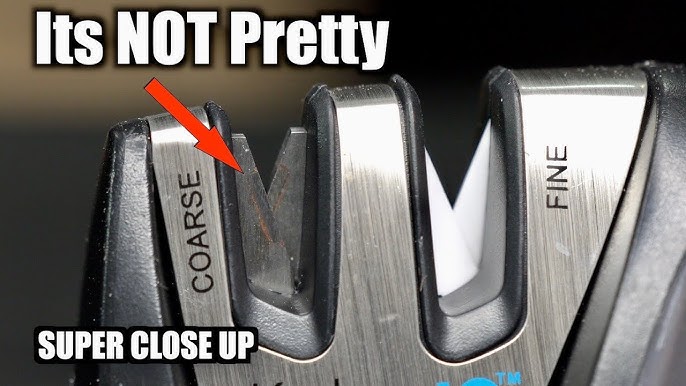
The COARSE slot carbide jaws -- this is what contacts your knife edge at a fixed angle every single pull.
The Core Problem
Pull-through sharpeners assume all knives have the same edge angle. They don't. Japanese knives are 12-15 degrees, German knives are 16-20 degrees, and most pull-throughs are fixed at 20-22 degrees. This mismatch permanently damages blade geometry.
Why One Angle Does Not Fit All
Angle Mismatch
Japanese knives: 12-15 deg. German knives: 16-20 deg. Budget knives: 20 deg+. Pull-throughs typically use 20-22 deg. This angle does not match most Asian knives.
Over-Beveling
If your knife is 15 deg and the sharpener uses 20 deg, you are creating a wider secondary bevel that weakens the edge and destroys cutting performance.
Under-Beveling Damage
If your knife is 20 deg and the sharpener uses 15 deg, you remove excessive metal chasing the shallower angle -- far more metal loss than needed.
Cumulative Degradation
Each pull-through changes blade geometry. After 5-10 uses, your knife's original profile is permanently gone and cannot be restored without extensive regrinding.
Excessive Metal Removal
Material Loss Per Use
An average pull-through removes 30-100 microns per use. That is 5-10x what professional sharpening removes, shortening your knife's life dramatically.
Blade Lifespan Impact
A 2mm-tall edge becomes 1.5mm after years of pull-through sharpening. The blade loses structural integrity and the balance the manufacturer designed.
Inconsistent Results
Different pressure each session means uneven sharpening -- some spots sharper than others, resulting in a blade that steers and doesn't cut in a straight line.
What to Use Instead
Professional Sharpening
Angle inspection, proper beveling, minimal metal removal. Preserves blade geometry. $10-20 per knife.
Manual Whetstones
Full control over angle and pressure. Start with practice stones on inexpensive knives first.
Honing Between Sharpenings
A honing rod maintains the edge without removing metal, extending time between professional sharpenings.
Angle-Adjustable Sharpeners
If you need a home device, choose one with adjustable angles matched to your knife's specification.
Common Questions
How do I know my knife's original angle?
Check the manufacturer's spec. Most Asian brands are 12-15 deg, most German brands are 16-20 deg. When in doubt, assume 15-20 deg and have a professional confirm.
Can a professional sharpener fix pull-through damage?
Often yes, but it requires regrinding to restore original geometry. This takes more time and costs more than a standard sharpening.
Are pull-throughs ever acceptable?
On budget knives where the factory angle matches the sharpener's fixed angle (usually 20 deg). Even then, professional sharpening gives more precise results.
Why do stores sell them if they damage knives?
Low price point and ease of use drive sales. Customers don't realize the long-term damage until it's done.
Services We Offer in Austin
Explore our full range of professional sharpening and blade restoration services
Kitchen Knives
Chef, paring, and serrated kitchen blade sharpening
Chef Knife Sharpening
Professional chef blade restoration
Santoku Knife Sharpening
Specialized Japanese blade technique
Paring Knife Sharpening
Precision small blade work
Pocket Knives
EDC and collectible blade care
Folding Knife Sharpening
Safe and effective folding blade service
Scissors & Shears
Salon, kitchen, and fabric scissor work
Scissors Sharpening
Precision scissor blade restoration
Garden Tool Sharpening
Pruners, hedge shears, and more
Tools & Equipment
Chisels and specialty tools
Protect Your Investment
Get Professional Sharpening
Professional sharpening is affordable, quick, and actually preserves your knives instead of destroying them.