Professional Sharpening — Austin, TX
Whetstone vs. Pull-Through Sharpener: A Professional's Honest Breakdown
If you've ever stood in a kitchen store looking at the wall of sharpening options — pull-throughs for $25, whetstones for $40, electric sharpeners for $200 — and wondered which one is actually going to keep your knives sharp without ruining them, this is the article you need.
I'm Michael. I run Seriously Fast Sharpening in Austin — the #1 ranked sharpening service in the city with144 reviews, 4.8 stars. I sharpen knives for a living, I've trained sharpeners in nine states, and every single week I see exactly what each of these tools does to a knife over time. Here's the unfiltered truth.
Quick Comparison
| Pull-Through | Electric Sharpener | Whetstone | |
|---|---|---|---|
| Skill required | None | Low | High (10–20 hrs) |
| Edge quality | Poor to fair | Fair to good | Excellent |
| Metal removed | Aggressive | Moderate | Minimal |
| Long-term damage | High | Moderate | None |
| Works on Japanese knives | No | Some models | Yes |
| Cost | $15–$80 | $80–$400 | $40–$300 |
| Knife lifespan | Shortens significantly | Shortens moderately | Preserves or extends |
Bottom line: a whetstone is the right tool for any knife worth more than $40. A pull-through costs you more knife over time than it saves you in time. Electric sharpeners sit in the middle.
How Pull-Through Sharpeners Work
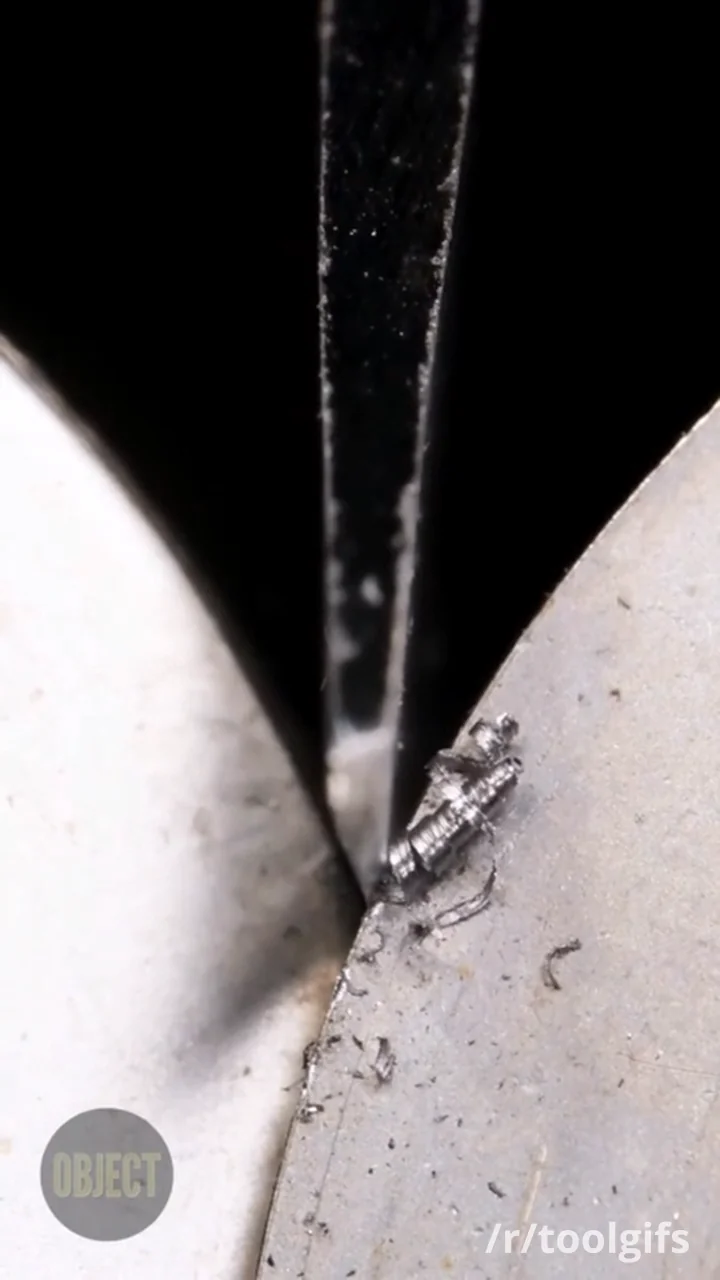
A pull-through sharpener has one or more slots with two abrasive wheels — usually carbide for coarse and ceramic for fine — angled in a V-shape at a fixed angle. You drag the blade through. The wheels scrape metal off both sides simultaneously. The blade is passive. The angle is decided by the manufacturer, not by your knife.
The fixed-angle problem
Japanese knives are designed at 10–15° per side. European knives at 17–22°. Most pull-throughs are fixed at ~20°. Run a Japanese knife through and you're not sharpening it — you're regrinding it to a geometry the steel wasn't heat-treated for.
The aggression problem
Carbide wheels remove metal in chunks, not thin passes. I see knives every month whose edges have been ground back 5–8mm. The blade profile is now concave instead of convex. The tip is blunted. These knives require aggressive thinning to recover — if they can be recovered at all.
When pull-throughs are acceptable
- –Budget knives under $30 — nothing premium to destroy
- –Bait knives, fishing knives, anything that gets abused anyway
- –Emergency Tuesday-night dullness — use it, then book a professional sharpening to fix it
How Whetstones Work
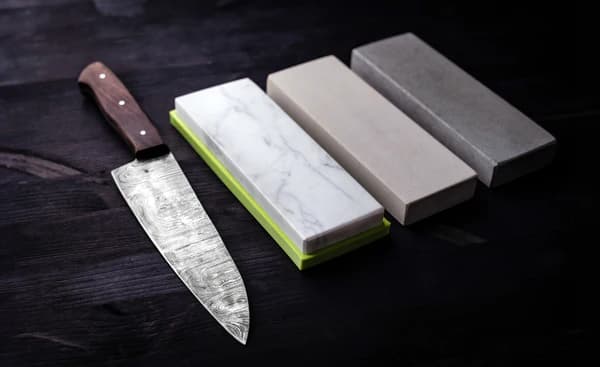
A whetstone is a flat abrasive block you draw the blade across at a controlled angle. You control the angle. You control the pressure. You control which part of the edge gets contact and for how long. The blade is active, not passive. You match the knife's existing geometry — you don't force it into a fixed slot.
Grit Reference
Why whetstones preserve knives
Whetstones remove metal slowly and uniformly — a few thousandths of an inch per session, not millimeters. A properly maintained knife sharpened on a whetstone every 6–12 months will outlive the cook. I have customers whose grandmothers' carbon steel knives I sharpen — 50+ years old, maintained on stones their entire lives, still functional and beautiful. I have never sharpened a 50-year-old pull-through-sharpened knife. They got thrown out 30 years in.
The honest tradeoff: skill
Whetstones are not forgiving when you start. Angle inconsistency, uneven pressure, and not recognizing when a burr forms are all real problems for beginners. Budget 10–20 hours of practice on a cheap knife before you trust yourself on a good one. The payoff is complete control of your edge for the rest of your life.
Featured — Outdoors55
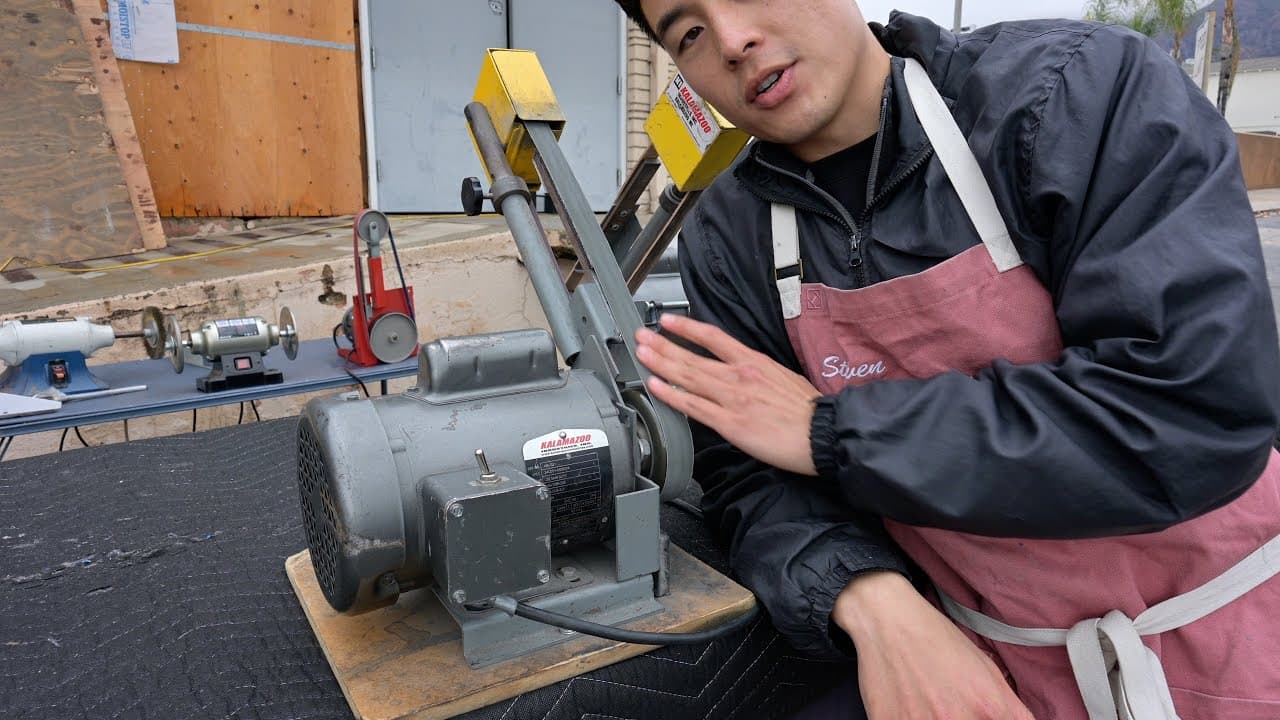
Industrial Belt Grinders: The Kalamazoo in Action
Steven from Outdoors55 breaks down the Kalamazoo industrial belt grinder — one tier above the Work Sharp in a professional setup. This is the class of equipment that separates a dedicated sharpening service from a kitchen drawer pull-through.
Electric Sharpeners — Where Do They Fit?
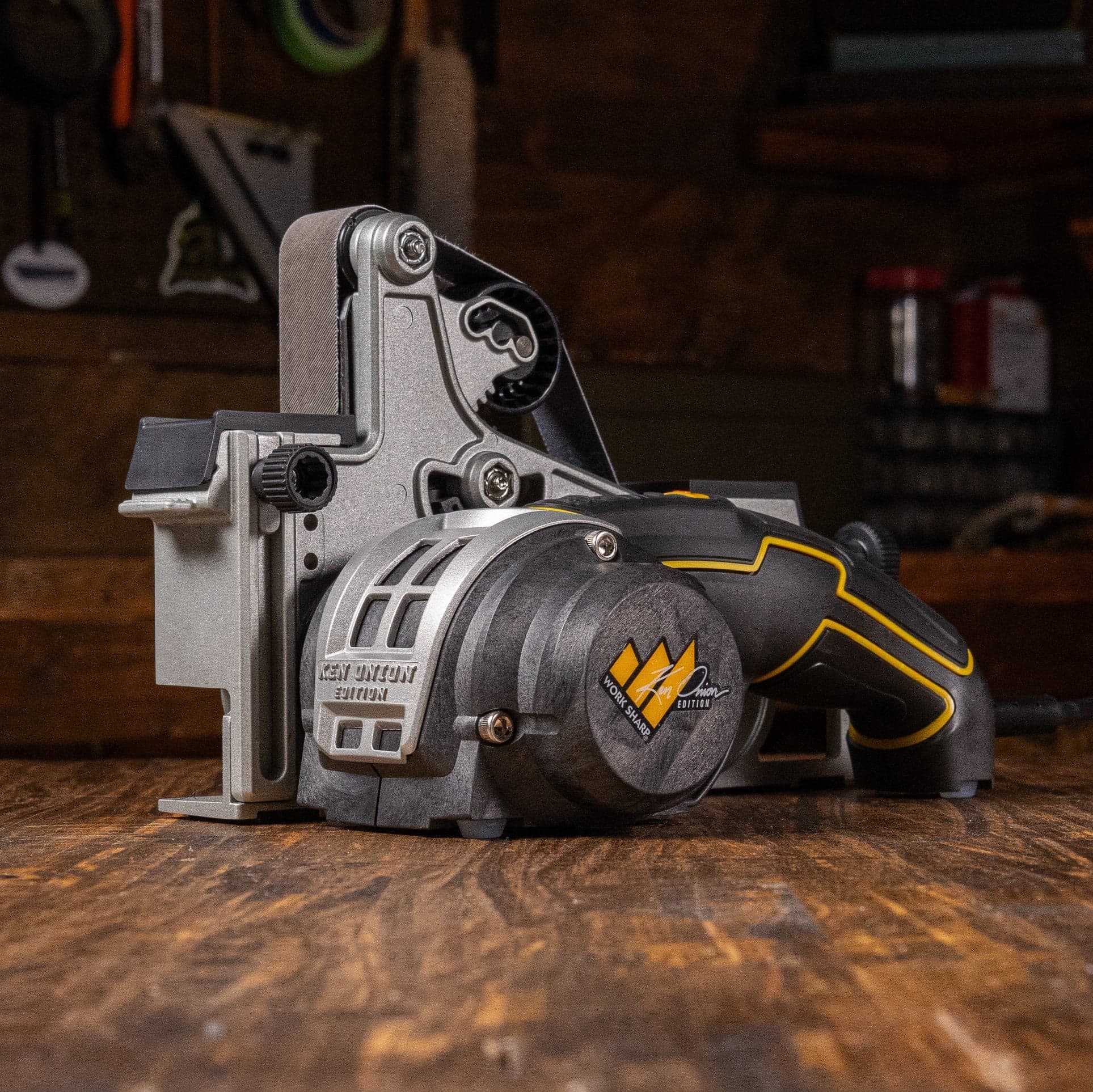
Electric sharpeners are mechanically powered pull-throughs with more control �� better abrasives, adjustable angles on higher-end models, slower and more uniform metal removal. Two I'll endorse for home cooks who don't want to learn the whetstone:
Work Sharp Precision Adjust Elite
Recommended~$160
Fully adjustable angle. Works on Japanese knives. Uses real abrasive belts, not carbide wheels. The honest middle-ground recommendation.
Chef'sChoice Trizor XV
Recommended~$160
Fixed 15° EdgeSelect angle. Designed to convert European knives to Japanese-style edges. Aggressive on first use, gentle on maintenance.
Avoid:
Anything under $80, anything sold at a grocery store, anything promising to sharpen with "no skill required" in under a minute. Those are pull-throughs with a motor and they damage knives just as fast.
The Cost-Over-Time Math
Scenario A — 10 Years
Pull-through every 6 weeks
$215
Sharpener $35 + knife replacement ~$180 at year 7
One mediocre knife, replaced once
Scenario B — 10 Years
Professional sharpening 2x/year
$300
$15 per knife × 20 visits — no replacement needed
Same knife, original geometry preserved
Scenario C — 10 Years
Whetstone at home
$75
1,000/6,000 stone $60 + one professional sharpen
Cheapest option with the skill. Knife preserved.
The pull-through isn't even the cheapest option once you factor in knife replacement. It's just the easiest today.
Recommendation by Knife Type
Japanese knives — gyuto, santoku, nakiri, sujihiki
Never use a pull-through. Whetstone only, or professional sharpening.
The acute angles and hard steel are incompatible with fixed-angle grinding. A single pass through a carbide pull-through can chip a hard Japanese edge.
European / German knives — Wüsthof, Henckels, Victorinox
Pull-through is acceptable for maintenance between professional sharpenings — but I'd still recommend against it as a primary method.
A Work Sharp Precision Adjust or a 1,000/6,000 whetstone will serve you better long-term.
Budget knives — $20 and under
Pull-through is fine.
No premium edge geometry to preserve. That said — I can still get a $20 knife sharper than a pull-through ever will.
Serrated knives
None of the above.
Serrated edges require sharpening each individual scallop. A pull-through with a serrated slot doesn't sharpen — it grinds the points off. Professional sharpening or replacement only.
People Also Ask
The Bottom Line
You have a Japanese knife worth $80+
Never touch a pull-through. Whetstone, or let a professional handle it.
You have good European knives and don't want to learn stone work
Professional sharpening every 6–12 months, honing steel between visits. Simple.
You want to DIY and are willing to practice
Buy a 1,000/6,000 combo stone. It's the cheapest long-term option and you'll actually enjoy it.
You have budget knives and just want them sharp
The pull-through will do the job. No premium edge to destroy.
Austin's #1 Ranked Sharpening Service
Not Sure How Bad the Damage Is?
Bring me one knife. I'll show you what its actual edge looks like and what it should look like. Chip and tip repair included. Mobile pickup across the Austin metro.