Stop Using Pull-Through Knife Sharpeners
A professional sharpener reveals why pull-through sharpeners destroy your knives, and what to use instead.
See the Damage
What a Pull-Through Actually Does to Your Edge
I'm a professional knife sharpener. The single most common thing I see is knives destroyed by pull-through sharpeners. Customers bring in $200 Wüsthofs and $300 Shuns with edges that look like they were attacked with a cheese grater. Every single time, the same story: “I've been using my pull-through sharpener and it just stopped working.”
It didn't stop working. It was never working. It was slowly destroying your knife the entire time.
What a Pull-Through Sharpener Actually Does to Your Knife
Carbide Pull-Throughs
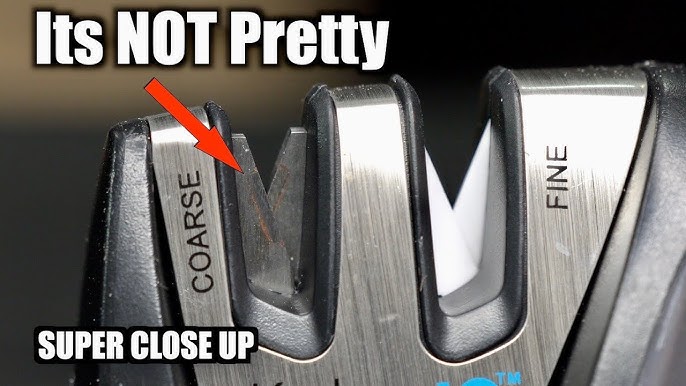
Most Destructive- They don't sharpen, they SCRAPE metal off using hardened carbide plates
- Like dragging your blade across a concrete curb at a fixed angle
- Remove far more metal than necessary with each pass
- Create rough, jagged edges that feel sharp for one use then dull immediately
- Fixed 20–22° angle destroys Japanese knife geometry designed at 12–15°
Ceramic Pull-Throughs
Still Problematic- Less aggressive than carbide but same fundamental problem
- Fixed angle that doesn't match your knife's design
- Creates inconsistent edge quality
- Better than carbide, but still inferior to proper sharpening
What Your Edge Actually Looks Like
Clean, consistent bevel. Uniform micro-teeth. Precise angle. Organized, aligned steel.
Similar to professional with minor inconsistencies. Excellent edge quality and performance.
Ragged, torn metal. Inconsistent angle. Deep scratches. Chunks missing. Structural chaos.
The Five Specific Ways Pull-Throughs Damage Your Knife
1. Excessive Metal Removal
A professional sharpening removes microns of steel, just enough to create a new edge. A pull-through scrapes off 10–50× more metal per pass. Your knife has a finite amount of steel. Every pull-through session dramatically shortens its life.
A knife professionally sharpened 3×/year lasts 20–30 years. A knife pull-through sharpened weekly might last 5 years.
2. Angle Destruction
Your knife was designed with a specific edge geometry. Pull-throughs use a fixed angle regardless. Every pass at the wrong angle reshapes your knife away from its designed performance.
After months of pull-through use, the original factory geometry is permanently gone.
3. Edge Asymmetry Destruction
Quality Japanese knives often have asymmetric bevels (70/30 or 80/20 ratios) that give them precision. Pull-throughs treat both sides identically, destroying this carefully designed geometry.
The result: your knife starts to steer (curve during cuts) instead of cutting straight. The precision that made Japanese knives valuable is permanently lost.
4. Micro-Fracturing
The aggressive scraping creates invisible micro-fractures along the edge. These cracks propagate during use, causing the edge to chip unexpectedly.
"My knife keeps chipping", It's not the knife. It's the damage from the pull-through creating structural weakness in the steel.
5. The Addiction Cycle
Pull-through creates rough, toothy edge that feels sharp initially
Rough edge dulls within 1–3 uses because it's structurally compromised
Pull through again, removing more metal, creating more damage
After 6–12 months: knife has lost significant steel, edge profile is ruined
“But It Makes My Knife Sharp!”
Yes, a pull-through creates an edge that feels sharp momentarily. But there's a critical difference between creating an edge and creating a good edge.
A saw also “cuts”, but you wouldn't use a saw to slice a tomato.
A rough, torn edge will cut paper and feel sharp to touch. But it won't cleanly slice a ripe tomato without squishing it, won't produce paper-thin onion slices, and won't glide through herbs without bruising them.
Pull-Through “Sharp”
- Blunt-force sharp
- Tears and crushes food
- Dulls after 1–3 uses
- Damages knife long-term
Proper Sharpening “Sharp”
- Precision sharp
- Clean slices without crushing
- Stays sharp for weeks/months
- Preserves knife lifespan
What to Use Instead
Real alternatives at every price point, from free right now to serious DIY investment:
Free Right Now
Stop using the pull-through. Seriously. A dull knife maintained with a honing steel is better than a knife being actively destroyed.
Immediate Action$25 Investment
Buy a ceramic honing rod. Hone before each use. This alone extends the time between sharpenings dramatically.
Maintenance Tool$10–20 Per Knife, 2–3× Per Year
Professional sharpening. Your knives stay in factory condition indefinitely. No learning curve, no equipment, no mistakes. We charge $10–20 per kitchen knife by size.
Recommended$50–200 If You Want to Learn
Buy a whetstone set (1000/3000 grit minimum). Watch tutorials. Practice on cheap knives first, the skill lasts forever.
DIY Skill Building$200–500 Precision Without Practice
A guided sharpening system (Edge Pro, KME, Work Sharp) gives professional-level results with a learning curve of hours, not months.
Advanced DIYThe Exception, When a Pull-Through Is Fine
Let's be fair. There are extremely limited scenarios:
If your knife cost less than $20 and you don't care about it lasting
If you're in a genuine emergency (Thanksgiving dinner, only option available)
If the alternative is using a dangerously dull knife and you have no other option
In all cases: use the ceramic slot, never the carbide slot, and use minimal passes (1–2 max).
Protect Your Investment
It's Not Too Late
If your knife has been through the pull-through cycle, a professional sharpening can restore the edge geometry and give it a fresh start.