Professional Sharpening Guide, 2026
Cutco Knife Sharpening:
A Former Rep's Honest Guide From the Sharpening Bench
I sold Cutco. I sharpen them weekly. Here's what I've learned.
By Michael · Seriously Fast Sharpening |20,000+ Blades Sharpened |4.8★ · 144 Google Reviews |Former Vector Marketing Rep
Cutco is one of the most argued-about knife brands in America. Some people love them. Their grandmother bought a set in 1972 and it still cuts. Other people call them overpriced MLM products sold by college kids who've never worked in a kitchen.
Both takes have something to them. Neither tells the full story.
I have a weird history with Cutco. I sold them myself, door-to-door, as my first commission-only job. Years later I started a sharpening service in Austin and built it into a 144-review, 4.8-star operation. I've now sharpened over 20,000 knives, and Cutcos show up on my bench every week. I also trained Daxton Camero, a former Cutco rep, in professional sharpening. Same product knowledge, applied from the other side.
So I've looked at Cutco as a salesperson, as a sharpener, and as someone who's taught other people to sharpen them. That's a perspective most people writing about Cutco online don't have.
This article is the honest version. We'll cover what Cutco knives actually are, how they're built, how to sharpen them properly, what the warranty really covers, and whether they're worth the price. If you own a Cutco, are thinking about buying one, or just inherited a set from family, this is the guide.
Quick Answer
Cutco knives can be sharpened, but most pull-through and electric sharpeners will damage them. The patented Double-D serrated edges are especially vulnerable. Your best options are: (1) send them to Cutco for their free Forever Sharp factory service (4 to 6 weeks), (2) for plain-edge Cutcos only, find a professional sharpener or sharpen on a 1,000-grit whetstone at 20 degrees per side, or (3) skip the home sharpening on Double-D pieces entirely and rely on Cutco's factory service. Never use a pull-through with a serrated slot. It grinds the points off the teeth and the knife is done.
The Cutco Story (Brief)
Cutco knives are made in Olean, New York. Not “designed in” New York. Manufactured there, in the same factory complex they've used since 1949.
That's rare. Most knife brands at Cutco's price point manufacture in Asia and stamp “USA” on the box. Cutco actually makes their knives in America, with American steel.
The company started as Alcoa's cutlery division before becoming independent. They're privately held, employee-owned through an ESOP, and have been profitable for decades. As a manufacturer, they're real.
What's controversial is how they sell. Cutco's main sales channel is Vector Marketing, a direct sales subsidiary that recruits college students for commission-only door-to-door work. The model has been called everything from a legitimate first sales job to a pyramid scheme. The knives themselves are made by Cutco, in New York, by people who know what they're doing.
What Makes Cutco Different (The Double-D Edge)
The one thing that sets Cutco apart from every other knife brand is their patented Double-D recessed edge.
It's not a serration. It's not a plain edge. It's a hybrid geometry, and it's the reason most sharpeners won't touch a Cutco.
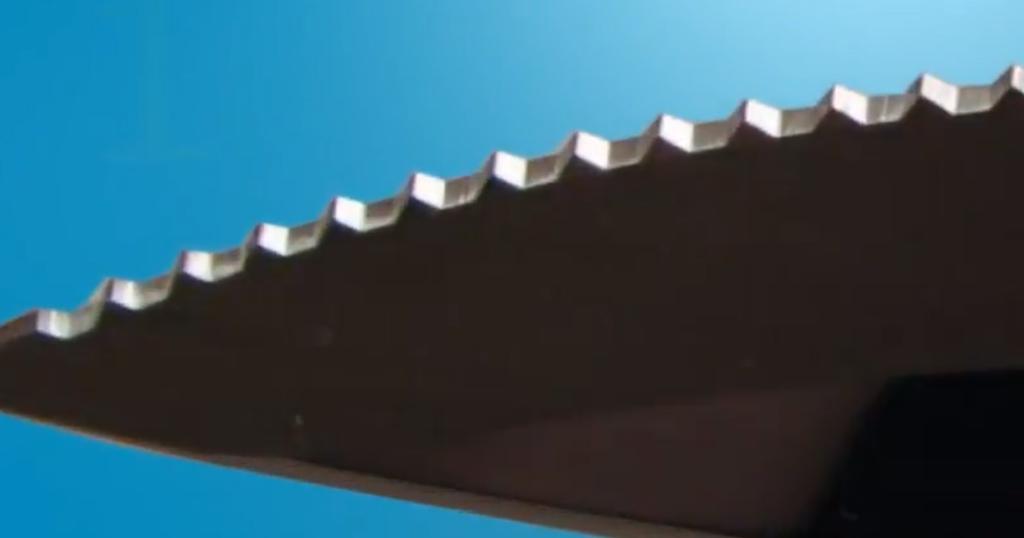
The cutting edge is recessed into the blade. A series of pointed crowns sit higher than the cutting edge and ride along the surface of whatever you're cutting. The crowns don't cut. They support the blade and guide it. The actual cutting happens between the crowns, on the sharpened concave arcs.
Two Advantages
- The cutting edge stays sharp longer because the crowns take the impact wear, not the edge itself.
- It performs like a serrated knife on tough exteriors (bread crust, tomato skin, roast crust) and like a smooth edge on soft interiors.
Two Disadvantages
- It can't be sharpened with standard tools. A pull-through grinds the crowns off. Most sharpeners (myself included) don't work on Double-D edges. Cutco's factory service does it better than anyone could replicate.
- After many years of heavy use, the crowns wear down enough that the cutting edge starts hitting the cutting board, which dulls it faster. At that point, the knife needs to be re-ground at Cutco's factory.
The Double-D is a real innovation. It also means that if you own one, you've got a knife with a specific maintenance path: factory service or nothing. That's fine if you know it going in. It's a problem if you don't.
Are Cutco Knives Actually Good?
Most articles dance around this question. I'll just answer it.
Yes, Cutco knives are good. They're also overpriced for what they are.
Both can be true.
What Cutco does well
- The steel is legitimate. Cutco uses 440A high-carbon stainless, heat-treated to around 56-58 HRC. Wüsthof uses similar steel. It holds an edge well, sharpens easily, and handles typical home use.
- The construction is solid. Full tang, riveted handles, balanced weight. I've never seen a Cutco fail at the handle or develop structural problems. 75 years of cumulative customer history and I haven't seen one break.
- The Forever Sharp warranty is real. Send Cutco any knife, any age, and they'll re-grind it for free. Forever. I've seen 50-year-old Cutcos come back from factory service looking brand new. No other knife company offers this.
- The handles fit a lot of hands. Cutco's Wedge-Lock design works for smaller hands and arthritic hands better than most brands. That matters more than knife reviewers admit.
What Cutco doesn't do well
- The edge is thick for fine work. Cutco's geometry is built for durability, not precision. Compare a Cutco chef's knife to a Japanese gyuto and you'll feel it. The Cutco is a workhorse. The gyuto is a scalpel.
- The Double-D locks you into Cutco's ecosystem. Once you own a Double-D, you're stuck with factory service for sharpening. That's a real cost of ownership most buyers don't think about when they're sitting at the kitchen table getting the pitch.
- The price doesn't match the steel. A Cutco chef's knife is around $130. For that money you can get a Wüsthof Classic (better steel, better edge) or a Tojiro DP gyuto (much better steel, much better edge). The Cutco premium is paying for the sales model, the warranty, and the brand. Not the metal.
- They're heavy. Some people like that. Many don't.
Who Cutco actually makes sense for
Buy a Cutco if you fit at least two of these:
- You want one set of knives that will last 30+ years with minimal effort.
- You like the Double-D for specific foods (bread, tomatoes, crusty meat).
- You're not going to sharpen them yourself. The factory warranty is genuinely valuable if you'll never own a whetstone.
- You inherited them. This is the most common Cutco owner I see. Don't replace what you have. Maintain it.
Skip Cutco if you:
- Want maximum edge performance for the price. Better options exist below $200.
- Want to learn whetstone sharpening. Plain-edge Cutcos work fine, but Double-D is a wall.
- Cook professionally or do fine prep work. Restaurant chefs don't use Cutco. There's a reason.
About the sales model
Cutco's reputation is complicated by Vector Marketing's recruiting practices. I sold Cutco myself when I was younger. The training was real. The sales pitch was scripted. Most reps made less money than they were promised.
It's not technically a pyramid scheme. There's no recruitment-based compensation. But Vector's recruiting often misrepresents the income potential of the job, and that's a real criticism.
That's a separate conversation from whether the knives are good. The knives are made by craftspeople in New York. You can buy a Cutco directly from the company's website without ever talking to a rep, and if you've decided you want one, that's usually the cleanest path.
The Cutco Knife Types
Cutco's catalog is bigger than most people realize. Over 30 active models. They fall into a few categories with different sharpening needs.
Plain-edge Cutcos
- Chef's Knife (1725). Cutco's 7 5/8" chef's knife. Plain edge, ~20° per side. The most universally useful piece in the lineup.
- Petite Chef (1728). Smaller version. Same geometry, same maintenance.
- Santoku-Style (1759). Cutco's Japanese-influenced model. Still 440A steel and Cutco geometry, not a real Japanese knife. Don't confuse them.
- Paring Knife (1720). Small utility knife. Easy to sharpen.
- Boning / Fillet. Flexible plain edge. Sharpens normally.
Double-D Cutcos
- Trimmer (1721). Cutco's flagship. The knife most associated with the brand. Cannot be sharpened with a pull-through, electric sharpener, or standard whetstone progression without destroying it.
- Slicer / Carver. Double-D on a longer blade. Same rules.
- Bread Knife. Actually serrated, not Double-D, despite looking similar.
Steak knives
Cutco steak knives are smaller Double-D. Same rules as the Trimmer. A pull-through with a serrated slot will destroy them. I see this every month. A customer brings in a set of Cutco steak knives that won't cut anymore, and the cause is always the same. Someone ran them through a pull-through.
Steak knife sets are also where Cutco's pricing gets hardest to defend. Eight Cutco steak knives run about $320. A comparable set of Wüsthof Classic Ikon steak knives is around $280, with better steel and a plain edge you can actually maintain.
Specialty pieces
- Cheese Knife. Specialty piece with a forked tip and partial serration. Light maintenance only.
- Spreader. Not a cutting knife. Doesn't need sharpening.
- Pizza Cutter, Kitchen Shears. Different mechanics. Outside the scope here.
What this means for your set
If you have a typical Cutco starter set (chef's knife, paring, Trimmer, steak knives), you're managing three different maintenance categories:
- Plain-edge pieces: whetstone or professional service
- Double-D pieces: factory service only
- Specialty pieces: minimal maintenance
This is a hidden cost of Cutco ownership. Your set isn't one thing. It's three. Most home sharpening tools only handle one of them.
The Forever Sharp Warranty
Cutco's Forever Guarantee is the single most impressive thing about the brand. Here's what it actually covers.
What's covered
- Performance Forever Guarantee. Cutco will sharpen your knife free of charge, forever. Any age. Any owner. The knife doesn't have to be in your name. You can pull a Cutco out of an estate sale and Cutco will sharpen it for you.
- Forever Guarantee. If the knife breaks or fails through normal use, Cutco repairs or replaces it. Handle damage, blade chips, broken tips, structural failure. Anything short of obvious abuse.
These are real. I've seen Cutco honor them on 40-year-old knives. The company is unusually serious about it.
What's not covered
- Obvious abuse (using a Cutco as a screwdriver, prying with the tip, repeated dishwasher use). They'll often repair these anyway, but they're not obligated to.
- Loss or theft.
- Cosmetic wear. Handles darken, blades develop patina. None of this affects function.
How factory sharpening actually works
You ship Cutco your knife (they provide a prepaid label or you pay yourself), they receive it, run it through their factory grinding process, and ship it back. Total turnaround is typically 4 to 6 weeks.
What happens at the factory: the knife is re-ground on industrial belt grinders to restore the original Cutco geometry. Plain-edge gets a fresh 20° bevel. Double-D gets the recessed cutting surface re-cut and the protective crowns re-pointed. Then polished, cleaned, and shipped back.
Honest tradeoff
Factory sharpening produces a knife that performs as well as new, but it removes more metal than careful hand sharpening would. A 50-year-old Cutco that's been sent in every few years for factory service will be visibly smaller than it started. That's not a defect. It's physics. Every sharpening removes metal. Cutco's process removes more than a whetstone would, in exchange for restoring the knife to factory spec.
When factory service makes sense
- You have a Double-D
- You don't have a plain-edge sharpener nearby
- The knife has real damage that needs repair
- You don't mind being without it for 4 to 6 weeks
When a local sharpener is better (plain-edge only)
- Plain-edge Cutcos
- You need it back fast
- You want to preserve more steel
The warranty math
Assume a chef's knife is sharpened 30 times over 60 years of household use, and local professional sharpening costs $15 each time:
Local sharpening, 60 years
- 30 sharpenings × $15 = $450
- Purchase price = $130
Total: $580
Cutco Forever Guarantee, 60 years
- Maintenance: $0 (warranty covers it)
- Purchase price = $130
Total: $130
$450 lifetime savings. Roughly 70% off the long-term cost. The warranty isn't marketing. It's a real, transferable financial benefit very few brands match.
How to Sharpen a Cutco Properly
Most Cutco owners never need to sharpen their own knives. Between the factory service and the knives' edge retention, infrequent maintenance is enough. But if you want to handle the plain-edge pieces yourself, here's how to do it without ruining them.
Plain-edge Cutcos
Plain-edge Cutcos are forgiving. They sharpen like any quality stainless kitchen knife.
What you need:
- 1,000-grit whetstone (a 1,000/6,000 combination is ideal)
- Flat surface
- Water for the stone
- Honing rod (optional but useful)
Process:
- Soak the stone for 10 minutes (skip for splash-and-go stones)
- Find the angle. Cutco plain edges sit around 20° per side. Match the existing bevel.
- Set the edge on 1,000 grit: alternating passes, light pressure, 10 to 15 passes per side
- Check for a burr along the whole edge
- Move to 6,000 grit: lighter pressure, fewer passes, refine
- Strop on leather or run a few light passes on a honing rod to align the edge
Cutco's 440A steel is soft enough that sharpening is fast. Don't overthink it.
Double-D Cutcos
I'll be direct: don't try to sharpen a Double-D at home, and don't expect most sharpeners (including me) to do it for you.
The Double-D needs a small-radius ceramic rod or specialized stone, independent sharpening of each recessed arc, re-pointing of the protective crowns, and specific angle work that takes serious training. There's no “good enough” version. Try to sharpen a Double-D with a pull-through and you'll grind the crowns down fast.
Your options for Double-D:
- Send it to Cutco for factory service (4 to 6 weeks, free) at cutco.com
- Let it dull naturally and use the Forever Guarantee when it's actually unusable
Cutco's factory is designed around their own geometry. They do this work better than independent sharpeners can, and they do it for free. There's no reason to look elsewhere.
Never
- Pull-through sharpeners. Destroy Double-D in one use. Damage plain edges over time.
- Electric sharpeners with fixed angles. Same problem.
- Grooved honing rods. Use smooth ceramic or smooth steel only.
- The dishwasher. Warps handles, corrodes steel. Hand-wash only.
- "Sharpening with a coffee mug." Doesn't work. Just rounds the edge.
The Family Cutco (Restoration Case Study)
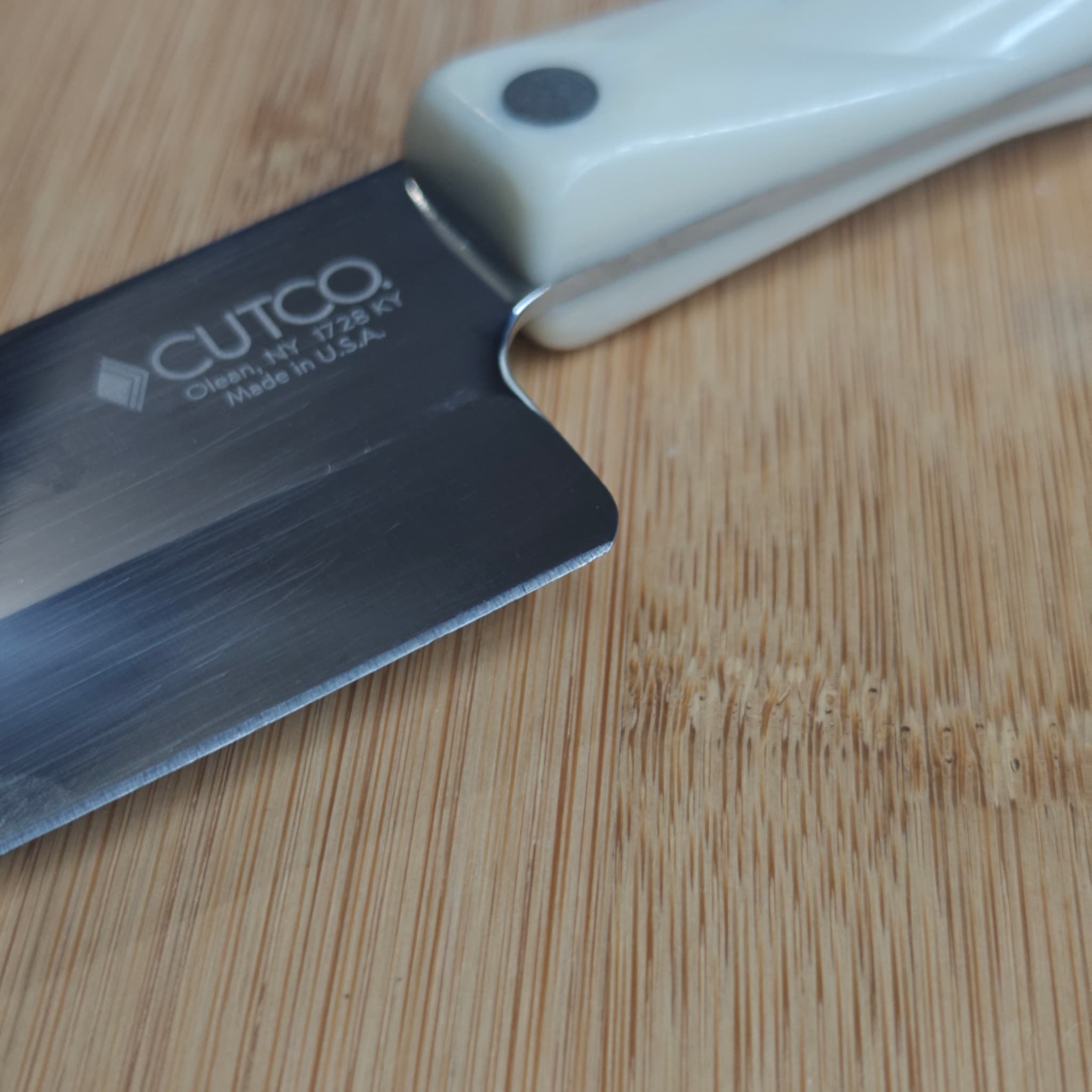
Before
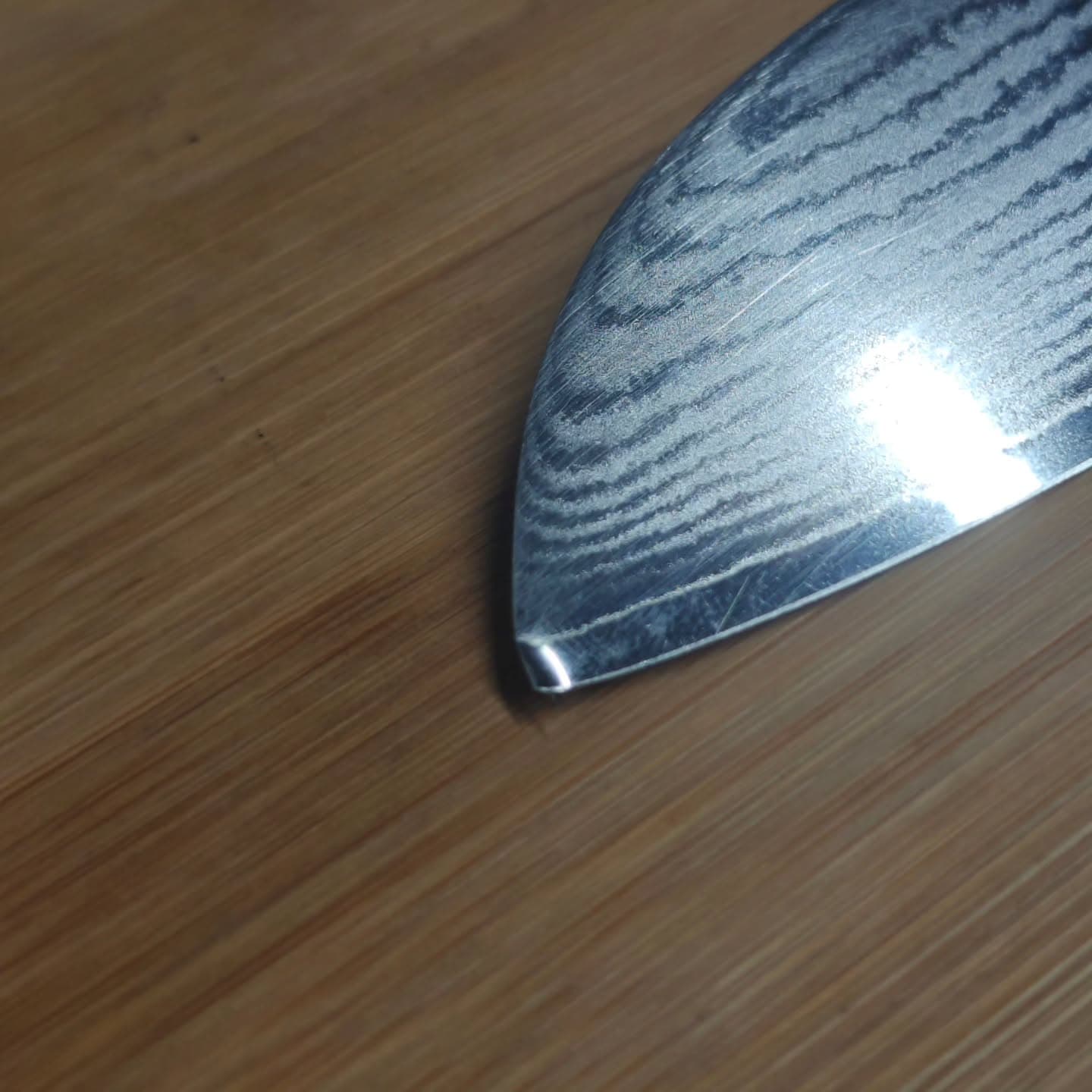
After

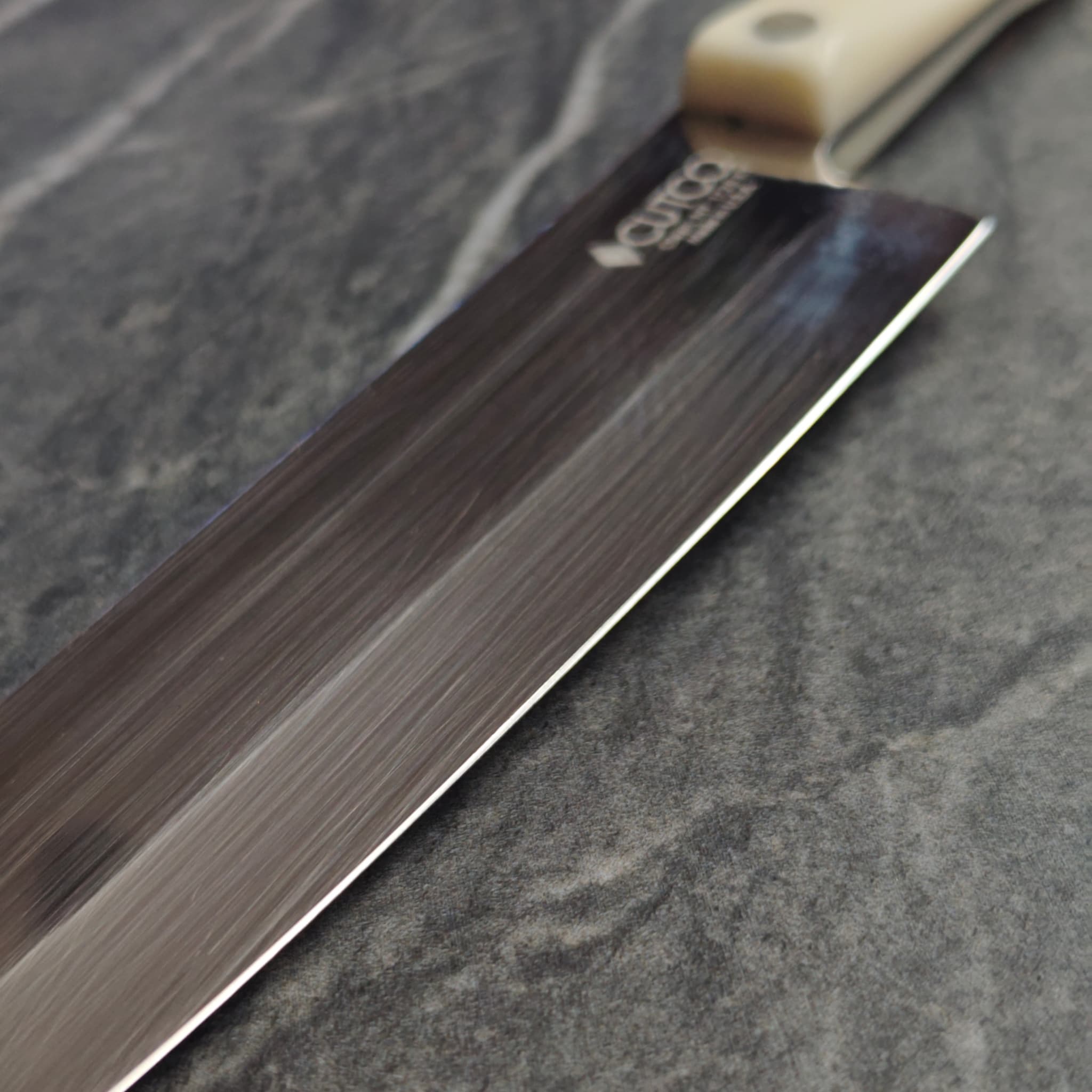
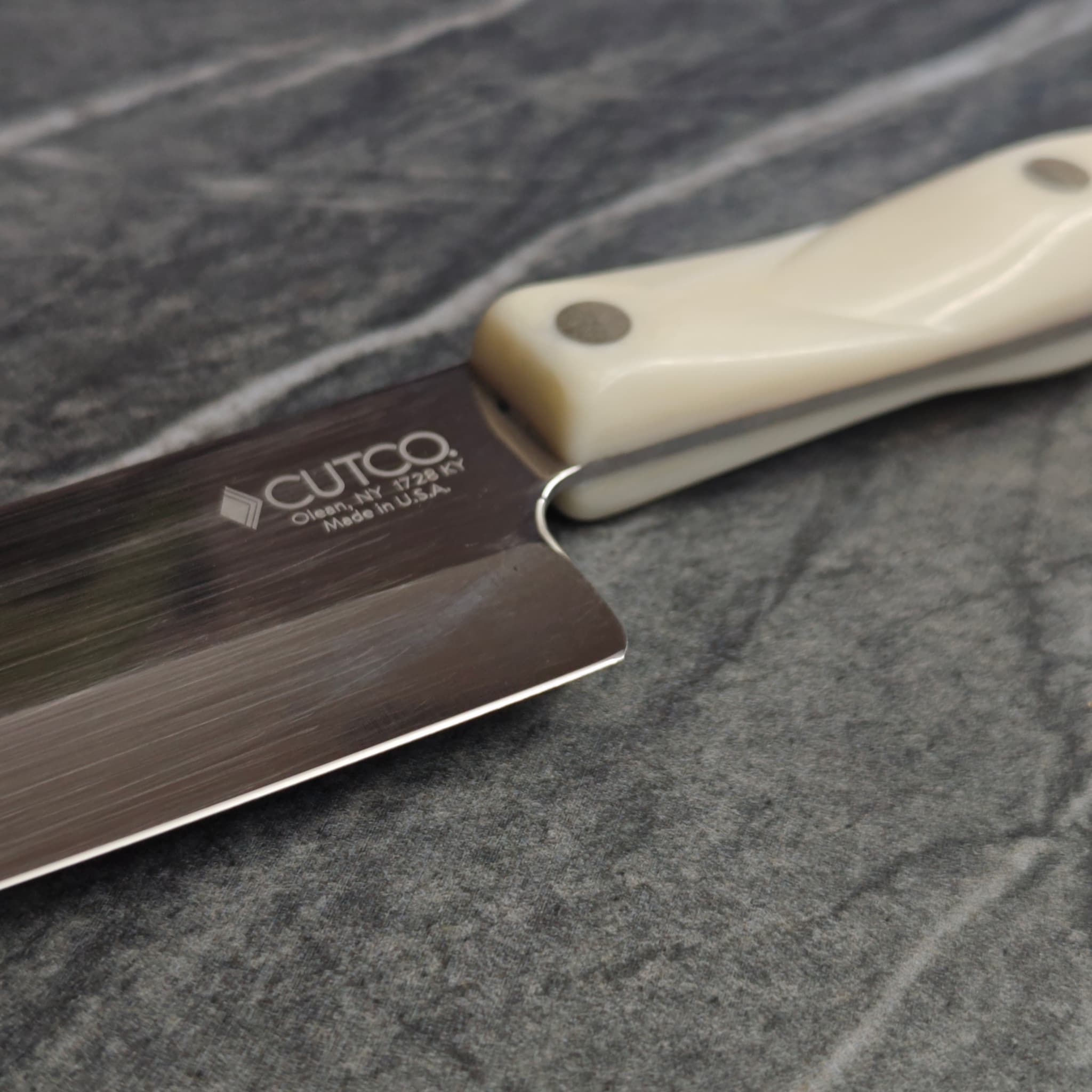
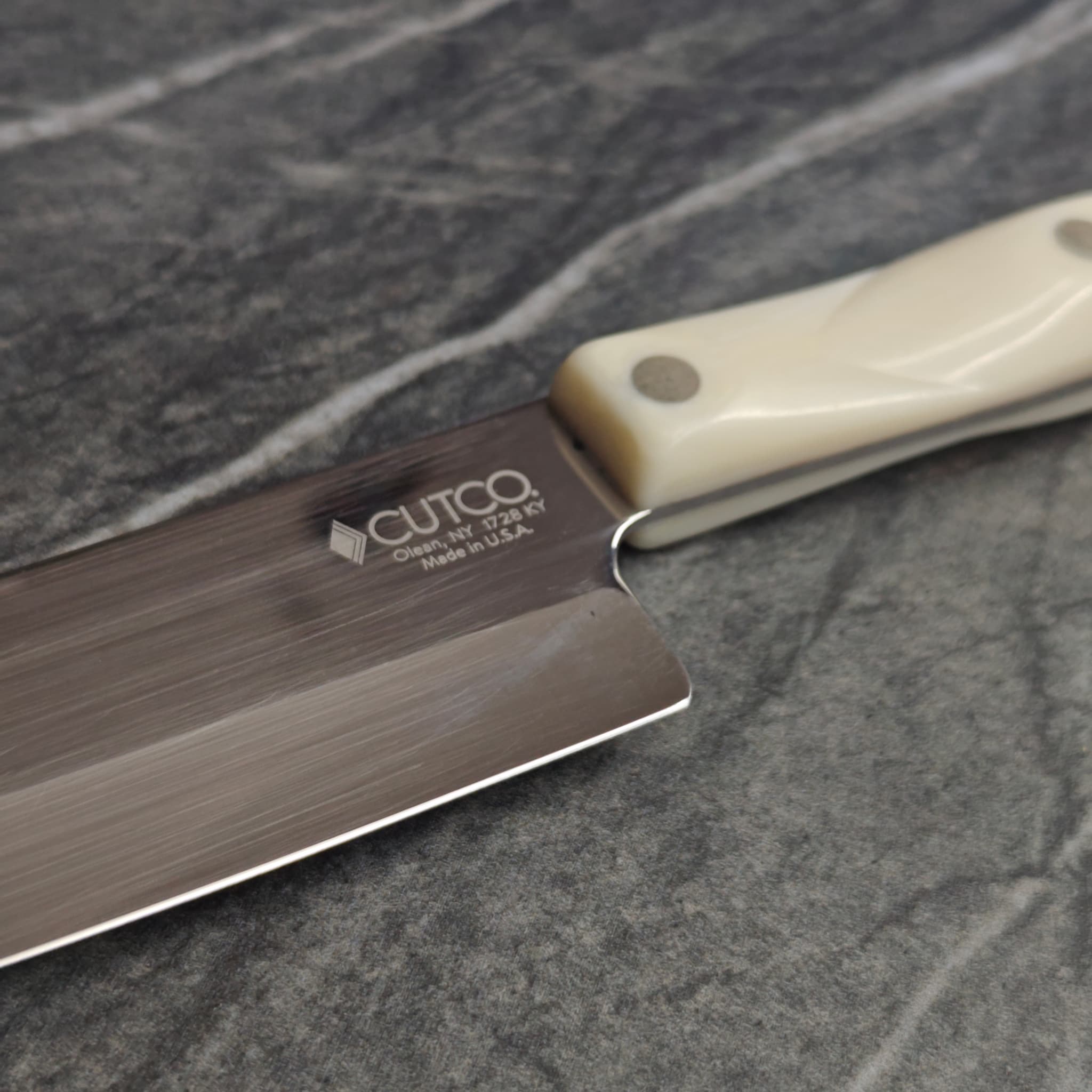
50 years of daily use, restored on stones
A customer brought me a Cutco that had been in her family for years. Bought new in the 1970s, used daily through three generations, never professionally sharpened in its entire life.
The edge was rolled over. Dull, slightly shiny apex, the way you see on a knife that's been used hard and never maintained. The handle was darkened with age. The blade had a light patina. The spine had cutting board scars from 50 years in working kitchens.
But the bones were perfect. That's the thing about Cutco. The steel doesn't fail. The construction doesn't fail. After 50 years it was structurally identical to the day it was unboxed. It just needed someone to restore the edge.
I took it through a full progression on stones. Set the edge on 1,000 grit, refined on 3,000, polished on 6,000. No belt grinder. Just careful passes, taking the minimum steel necessary.
She picked it up, ran it through a tomato, and it cut clean. She told me it was the first time in twenty years that knife had really cut. That's the case for Cutco done right. Not the best knife you can buy. But a knife your grandmother bought in 1972 that's still a knife in 2026, sharpenable, restorable, ready for another generation if someone gives it the right attention.
Cutco Maintenance and Care
Cutco knives are durable, but they're not indestructible. Most of the damaged Cutcos I see weren't worn out by use. They were damaged by maintenance.
Hand-wash only
Cutco's official position is that their knives are dishwasher safe. They're technically right. The steel won't rust in a dishwasher. The handles won't fall apart immediately.
What actually happens over time:
- The handle material darkens and degrades from the heat and detergent
- The blade develops a dull surface haze from the harsh wash cycle
- The edge dulls faster than it should because of repeated contact with other items in the rack
- Over years, the rivets can loosen
I've seen 10-year-old hand-washed Cutcos that look new and 10-year-old dishwasher Cutcos that look 30 years old. Same knife. Different care. Hand-wash with warm water and dish soap. Dry immediately. That's it.
Storage
Cutco sells a wooden block. That works fine. Magnetic strips also work. Drawers with edge guards work.
What doesn't work: throwing them loose in a drawer with other utensils. The Double-D crowns are particularly vulnerable to impact from other knives or hard objects. Every time a Double-D bangs against a stainless ladle, you're shortening its life.
Honing
For plain-edge Cutcos, run them down a smooth ceramic or smooth steel honing rod a few times every few uses. Light pressure, matching the bevel angle. This realigns the edge without removing metal.
Don't hone Double-D knives. The geometry doesn't respond to honing the way a plain edge does. If a Double-D feels dull, it needs actual sharpening (from Cutco), not honing.
What to do with a chipped or damaged Cutco
Call Cutco. The Forever Guarantee covers this. They'll either repair it or replace it. Don't try to grind out a chip yourself unless you know what you're doing. Bad chip repair on a Cutco can compromise the heat treatment near the damage.
Frequency
A typical home cook with a Cutco needs sharpening every 12 to 18 months. Heavy home cooks (someone who actually cooks daily) might need it every 6 to 12 months. Most Cutco owners go years between sharpenings, which is part of why the brand works for people who don't want to think about knives.
Vintage Cutco
Quick note before this section: I'm a sharpener, not a vintage Cutco collector. I sharpen old Cutcos every week, but I'm not the guy to tell you what a 1962 boning knife is worth on eBay. Here's what I can tell you from the bench.
How to identify a vintage Cutco
- Handle color. Modern Cutcos have a brown or "Pearl" handle. Older Cutcos (1950s through 1970s) often have darker brown or near-black handles. Truly old ones from the 1940s and early 1950s can have stag-pattern or jigged handles.
- Logo and stamping. The Cutco logo has changed several times. A "CUTCO" stamp with no model number is usually pre-1970. Model numbers in the 1700-series started in the 1970s.
- Construction details. Older Cutcos used different rivet patterns and slightly different handle shapes. The Wedge-Lock handle wasn't introduced until the late 1970s.
What they're worth
Most vintage Cutcos sell for $20 to $80 per knife on eBay or estate sales, regardless of age. The exceptions are complete original sets in original packaging, or specific rare models, which can run higher.
For sharpening purposes, the value doesn't matter. The steel and construction haven't changed dramatically. A 1965 Cutco chef's knife sharpens the same way as a 2026 Cutco chef's knife.
Should you restore an old one?
Yes, almost always. The Forever Guarantee applies to vintage Cutcos. Cutco will sharpen and repair a knife from 1960 the same way they'd handle one from last year. If you've inherited a set, it's worth maintaining.
If you want to do the maintenance yourself, the plain-edge models follow the standard whetstone process from the section above. Double-D models from any era go to Cutco's factory.
I see vintage Cutcos in restoration jobs more often than any other vintage knife brand. There's a reason. They were made to last and they did.
Should You Buy Cutco?
This is the question I get asked most. Here's the four-profile answer.
Buy Cutco if:
- You want one knife set that lasts decades with no thinking required. Cutco is built for this exact use case. Hand-wash, hone occasionally, send to factory every 5 to 10 years, knife lasts forever.
- You like the Double-D for specific foods. If you eat a lot of tomatoes, bread with crusts, or roasted meats with hard exteriors, the Double-D genuinely performs better than a plain edge on those tasks.
- You're not going to learn to sharpen. If a whetstone is never going to happen in your kitchen, Cutco's factory service makes the long-term math work.
- You've inherited a set. Don't replace it. Maintain it. The set you have is the same set Cutco sells today.
Don't buy Cutco if:
- You want the best knife for the money. Better options exist. Wüsthof Classic, Victorinox Fibrox Pro, Tojiro DP, MAC Pro. All deliver more edge quality per dollar.
- You want to learn whetstone sharpening. Plain-edge Cutcos work, but the Double-D pieces will frustrate you eventually.
- You cook seriously. Professional kitchens don't use Cutco. The geometry is wrong for fine prep work and the weight gets tiring over long shifts.
- You're getting the pitch and you feel pressured. Buy it because the knives work for you, not because you feel obligated. If you feel obligated, you can buy a single piece directly from Cutco.com later, on your own terms.
What I'd actually recommend most people
If you have $500 to spend on a kitchen knife setup:
Recommended Setup (~$325)
- Wüsthof Classic 8" Chef's Knife$160
- Victorinox Fibrox 4" Paring Knife$15
- Mercer Culinary Bread Knife$25
- Shapton 1,000/6,000 combination whetstone$80
- Smooth ceramic honing rod$30
- One professional sharpening per year for the chef's knife$15
Total: about $325, plus you keep $175 in your pocket and have a setup that will outlast Cutco's lifetime. If you have $500 and you want the lowest-effort path: buy three Cutco pieces and use them. Both answers are legitimate. They just optimize for different things.
Cutco vs. Other Brands
Quick positioning, because people ask.
Cutco vs. Wüsthof
Wüsthof has better steel and a finer edge. Cutco has a better warranty and lasts longer with no maintenance. Wüsthof wins on performance. Cutco wins on convenience.
Cutco vs. Henckels
Similar story. Henckels (the international line, not the cheaper "Henckels" branded stuff) is comparable quality steel at a lower price. Cutco still wins on warranty.
Cutco vs. Victorinox
Victorinox Fibrox Pro is a tenth the price with steel that's almost as good. If you want a working knife that costs nothing and sharpens easily, Victorinox is the answer. If you want a knife that feels substantial and comes with a lifetime of factory service, Cutco.
Cutco vs. Japanese knives
Different categories. Japanese knives (real ones, not "Japanese-style") use harder steel, take finer edges, and are designed for precision. Cutcos are workhorses. Most home cooks who think they want a Japanese knife actually want a Wüsthof. Most people who buy a Cutco wouldn't enjoy a Japanese knife.
Cutco vs. cheap brands (Farberware, Mainstays, etc.)
No contest. Cutco wins by a wide margin on every dimension that matters.
People Also Ask
When to Call Me
I'm Michael. I run Seriously Fast Sharpening in Austin. 144 reviews, 4.8 stars on Google, 20,000+ blades sharpened. If your Cutco isn't cutting like it used to, here's what I can do:
Plain-edge Cutcos (chef's knife, paring, santoku, boning)
I sharpen these regularly. Standard pricing.
Double-D Cutcos (Trimmer, steak knives, slicer)
I don't sharpen these. Send them to Cutco's factory service. It's free, it works, and the geometry is designed around their specific tooling. I'm honest about what I do well and what I don't.
Pricing for plain-edge Cutcos:
- Chip and tip repair included
- Mobile pickup available across the Austin metro
Not in Austin?
For plain-edge Cutcos
I sharpen plain-edge Cutcos by mail from anywhere in the country. Ship them in and I will send them back sharp.
Mail in your Cutco for sharpeningFor Double-D Cutcos
Send them to Cutco. Their factory service is free, takes 4 to 6 weeks, and produces a knife that performs like new.
Cutco factory service at cutco.comMichael
Seriously Fast Sharpening