Drop-Box Open 24/7

·

9407 Longvale Dr, North Austin

Kitchen Safety Alert

Why Dull Knives Are More Dangerous Than Sharp Ones

Yes, dull knives cause more injuries than sharp ones.

A dull blade requires far more force to cut — and more force means less control. When the blade finally bites through a tough surface like tomato skin, that stored pressure releases instantly and unpredictably, usually toward the hand holding the food. Sharp knives go exactly where you direct them. Dull knives slip. The physics are that simple, and ER data from 350,000+ annual knife injuries confirms it.

Written by Michael Kempf — professional knife sharpener serving Austin, TX since 2022. 130+ five-star reviews.

Key facts at a glance

30-Second Safety Check

Hold a sheet of printer paper by one edge and draw your knife down through it. What happens?

By the numbers

350,000+
knife lacerations treated in US ERs every year
Consumer Product Safety Commission
66%
of knife injuries strike fingers or thumbs
J. Emergency Medicine, 2013
94%
of knife injuries are lacerations
CPSC NEISS data
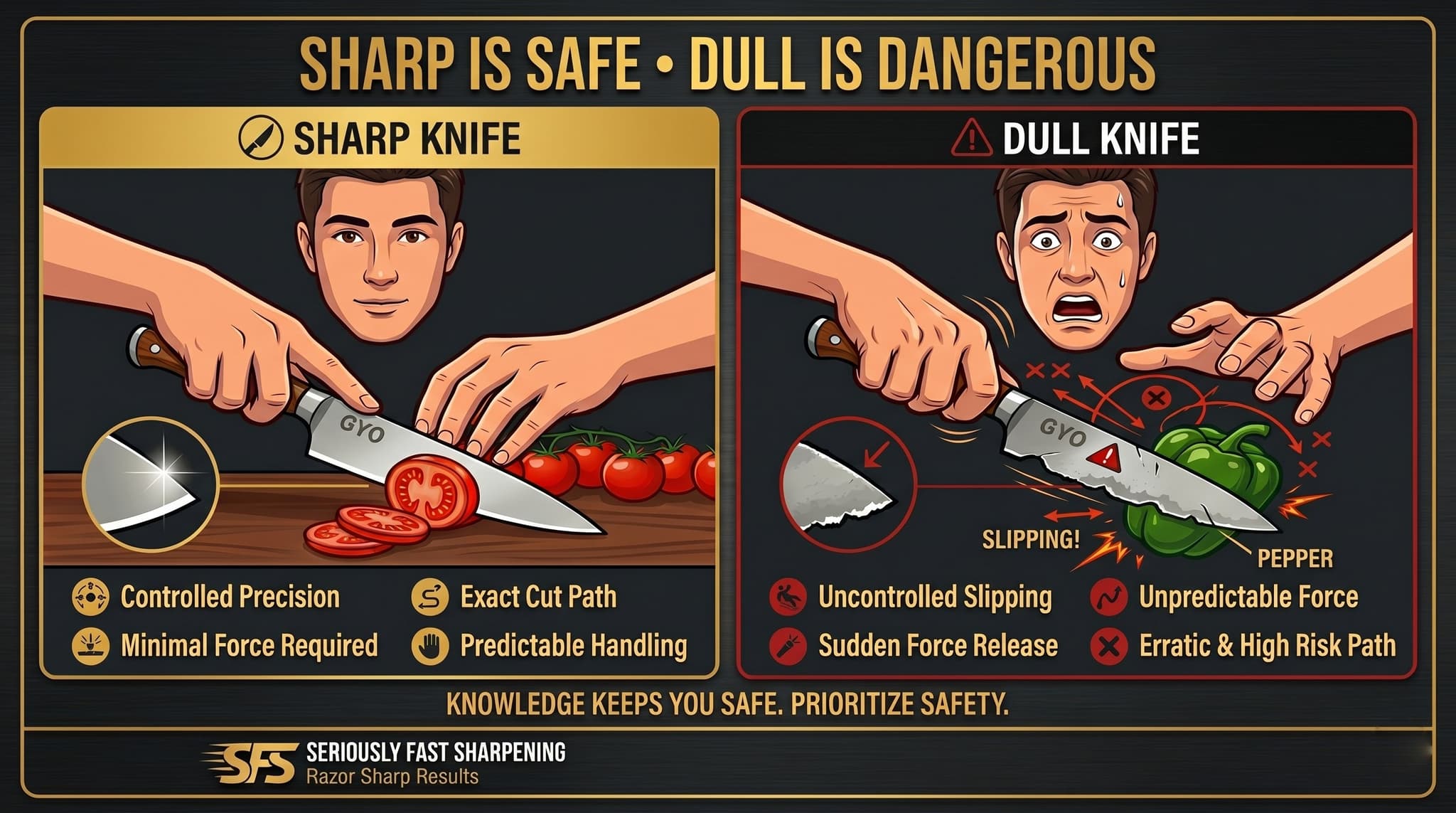
Sharp is Safe, Dull is Dangerous — infographic comparing a sharp knife (controlled precision, minimal force, exact cut path, predictable handling) against a dull knife (uncontrolled slipping, sudden force release, unpredictable force, erratic high-risk path)

Infographic: Seriously Fast Sharpening — Austin, TX

Worried your knives might be too dull?

Text me a photo and I'll give you an honest assessment — no pressure.

Text a Photo

Sharp vs Dull: The Critical Difference

Sharp Knife

Safer
Force Required
Low
Control Level
High
Accident Risk
Low
  • Precise, controlled cuts
  • Minimal pressure needed
  • Clean, smooth slicing
  • Reduced hand fatigue

Dull Knife

Dangerous
Force Required
High
Control Level
Low
Accident Risk
High
  • Unpredictable slipping
  • Excessive force required
  • Crushing and tearing
  • Hand strain and fatigue

Kitchen Safety Statistics

1,190

Knife injuries treated in US ERs every day

66%

Of injuries are to fingers or thumbs

86%

Strike the hand or fingers

94%

Are lacerations

Source: CPSC NEISS analysis, Journal of Emergency Medicine.

The Science Behind Dull Knife Dangers

Increased Pressure

More force
required to cut with a dull blade

Dull knives require significantly more pressure to cut through food — a consensus shared by Wüsthof, the University of Rochester Medical Center, and Mayo Clinic. That extra force is the root of every other danger on this page.

Loss of Control

Slipping
is the leading cause of knife injury

Per CPSC NEISS data, knife injuries most often occur when the blade slips during cutting or trimming. Dull blades slip more because they require pressure to cut — and the moment they break through, that stored force goes somewhere. Often into your fingers.

Crushing Damage

Jagged
wounds heal slower than clean cuts

Dull blades crush and tear tissue instead of slicing cleanly. Surgeons at Sequoia Institute and Mayo Clinic note that kitchen-knife cuts that reach tendons, nerves, or blood vessels — common when force and slippage combine — can cause lasting damage.

Want to go deeper? Learn how often you should sharpen your knives based on your usage, or compare DIY sharpening vs. professional sharpening to decide what's right for you. If you're ready to go safe today, see our flat-rate pricing — most kitchen knives start at $10, done-right, on-time service.

Austin, TX

Bring your dull knives to Austin's highest-rated sharpening service.

Drop off at the chest on Longvale — sharpened sharper than factory and ready by end of day. Starting at $10/knife. No payment until it's sharp.

Book Now — Same Day

Your Path to Kitchen Safety

Assess Your Knives

Test your knives with the paper test — a sharp knife should slice through paper cleanly without tearing.

Safety Check

Professional Sharpening

Get your knives professionally sharpened to restore proper blade geometry and optimal cutting performance. See our flat-rate pricing — most kitchen knives start at $10.

Expert Service

Maintain Sharpness

Regular maintenance and proper storage keep your knives sharp and safe for longer periods.

Long-term Safety

The Science of Knife Safety

Why Dull Knives Are More Dangerous

Contrary to popular belief, dull knives cause more kitchen accidents than sharp ones. Wüsthof states it plainly: “A sharp knife is a safe knife… The most common cause of kitchen injury is actually a dull knife because it requires more pressure while cutting.” The physics of cutting explains why.

1. Excessive Force Required

Dull knives require significantly more pressure to cut through food. This is the foundational danger — every other risk on this page stems from it. The University of Rochester Medical Center puts it simply: a dull blade needs more pressure to cut, increasing the chance that the knife will slip with great force behind it. When a dull blade finally breaks through tough skin — a tomato, a pepper, chicken skin — the sudden release of built-up pressure causes loss of control.

2. Unpredictable Behavior

Sharp knives bite into food surfaces immediately. Dull knives deflect, skate, and slide — especially on round, smooth, or slippery foods. Mayo Clinic's executive chef notes that the initial bite of a sharp edge is what keeps a knife (and the food) from slipping. A dull edge doesn't bite, so it slides until force overcomes friction — then suddenly cuts with unexpected speed.

3. Poor Cutting Technique

When a knife won't cut, people improvise. They saw. They rock. They press down with their body weight. Every one of these compensations violates proper knife technique and increases injury risk. Hand surgeons see the results: deep lacerations, tendon damage, nerve injury. Dr. Sanj Kakar, Mayo Clinic orthopedic surgeon, has treated patients who stuck a knife through their hand as it slipped.

4. Fatigue and Frustration

The extra effort required by a dull knife leads to hand fatigue. Tired hands are less precise. Frustrated cooks rush. Both conditions compound the risk — and research on hand/wrist ED visits shows knives account for 11% of all hand and wrist injuries treated in US emergency departments (Aceto et al., 2025).

Keep Your Austin Kitchen Safe

Most home cooks should have their knives professionally sharpened every 6 months. This aligns with recommendations from America's Test Kitchen (every few months to twice a year) and Wüsthof (once or twice a year). See the complete sharpening schedule guide.

Professional sharpening starts at just $10 for kitchen knives — a small price for kitchen safety.

Benefits of Sharp Knives

  • Precise control: Sharp knives cut exactly where intended
  • Less force needed: Reduced pressure means better control
  • Clean cuts: Sharp blades slice cleanly without tearing
  • Better technique: Proper cutting form is easier with sharp knives
  • Reduced fatigue: Less effort required for food preparation

Protect Your Family with Professional Sharpening

Don't risk kitchen accidents with dull knives. Get professional sharpening in Austin today.

Same-day service available · serving Austin and the surrounding metro

Frequently Asked Questions

Are dull knives more dangerous than sharp knives?

Yes — dull knives are more dangerous than sharp ones. They require significantly more pressure to cut through food, which reduces control and makes slipping far more likely. When a dull blade finally breaks through a tough surface like a tomato skin, the sudden release of stored pressure sends the knife in an unpredictable direction — typically toward the hand holding the food. Wüsthof, the University of Rochester Medical Center, and Mayo Clinic all confirm this relationship.

Why is a dull knife more dangerous?

A dull knife is more dangerous because it demands excessive force to cut. The physics are straightforward: more force means less fine-motor control over the blade. Dull blades also skip or slide off food surfaces instead of biting in cleanly, turning every cut into a slip hazard. When the blade finally catches, that built-up force transfers instantly — most often into the fingers or palm of the hand guiding the food.

How can I tell if my knife is too dull to be safe?

The quickest test is the paper test: hold a sheet of printer paper by one edge and draw the knife down through it. A safe, sharp knife slices cleanly with no tearing or deflecting. A dangerously dull knife will fold or shred the paper. You can also try the tomato test — a sharp blade glides through tomato skin with almost no pressure; a dull blade slips off the skin and requires force, which is exactly when accidents happen.

What is the most common dull-knife injury?

Lacerations to the fingers and thumb are the most common dull-knife injuries by a wide margin. CPSC NEISS data shows that 94% of knife injuries are lacerations, and 66% strike the fingers or thumbs specifically. These injuries most often happen during slipping or cutting motions when the blade loses purchase on a food surface — a scenario far more likely with a dull blade than a sharp one.

How often should I sharpen my knife to keep it safe?

Most home cooks should have their knives professionally sharpened every six months. Wüsthof recommends a full sharpening one to two times per year, while America's Test Kitchen suggests every few months depending on use. Between professional sharpenings, honing with a honing steel a few times per week realigns the edge without removing metal, extending the time between sharpening appointments and keeping the blade predictable and safe.

Does a sharp knife cut deeper than a dull one?

A sharp knife does cut more efficiently, but it does not cause more severe injuries in practice. The key difference is control: a sharp knife goes where you direct it and stops when you stop applying pressure. A dull knife requires force, slips unpredictably, and often causes deep lacerations from the sudden release of stored energy when the blade finally catches. ER data consistently shows dull knives produce more and worse injuries than sharp ones.

Sources

Primary and peer-reviewed sources for every stat and claim on this page.

  1. Smith, G.A. (2013). Knife-Related Injuries Treated in United States Emergency Departments, 1990–2008. Journal of Emergency Medicine, 45(3), 315–323. sciencedirect.com
  2. Aceto, M., Shaylor, J., & Zumsteg, J. (2025). Most Common Consumer Products Associated With Hand and Wrist Injuries Presenting to US Emergency Departments: An NEISS Database Analysis. HAND. journals.sagepub.com
  3. Wüsthof. How to Sharpen Your Wüsthof Knives. wusthof.com
  4. Consumer Reports. 7 Scariest Kitchen Accidents. consumerreports.org
  5. University of Rochester Medical Center. Be Careful With Kitchen Knives. Health Encyclopedia. urmc.rochester.edu
  6. Mayo Clinic News Network (2021). Mayo Clinic Minute: Sharpen your knife skills to avoid injury. newsnetwork.mayoclinic.org
  7. America's Test Kitchen. How Often Should You Sharpen Your Knife? americastestkitchen.com
  8. US Consumer Product Safety Commission. National Electronic Injury Surveillance System (NEISS). cpsc.gov
  9. Sequoia Institute for Surgical Services. Safe Cooking: How to Avoid and Handle Kitchen Knife Injuries. sisurgicalservices.com
For Journalists & Researchers

Need an expert source on this topic?

Covering kitchen safety, knife injuries, or why dull knives are dangerous? Michael can provide expert commentary and verified stats.

Qualified to speak on

  • Knife sharpening techniques and physics
  • Kitchen knife safety and injury prevention
  • Honing vs sharpening (steel rods, whetstones, angles)
  • Professional sharpening industry and pricing
  • Knife care, edge retention, and steel types

Michael Kempf — professional knife sharpener serving Austin, TX since 2022. Owner of Seriously Fast Sharpening. 130+ verified five-star Google reviews. Available for same-day interviews, photo shoots, and expert quotes.